

Learning by thinking: what a fifteen-minute post-mortem does that another game does not
Masters have always analysed their own games. Cognitive science explains why that habit, not raw volume, is what separates the players who improve from the players who just play.
Published 2026-09-03
Walk into any tournament hall after a round and you will see it: two players who were trying to destroy each other an hour ago, bent over the same board, moving pieces, arguing. The post-mortem is the oldest learning ritual in chess. Masters do one after every game. Club players almost never do, because the opponent has gone home and the stronger friend is not on the phone.
It turns out the ritual has a scientific basis that goes beyond “experience is good.” Experience, on its own, is a surprisingly weak teacher. What the research keeps finding is that the players who improve are not the ones who play the most. They are the ones who think about what they played.
A library, not a faster calculator
The founding study of chess psychology is Adriaan de Groot's, begun in the 1930s and published in English in 1965. He had players from club level to grandmaster think aloud while choosing a move, and found something that still surprises people: the masters did not calculate deeper or wider than the amateurs. They saw the position better, and considered strong candidate moves almost at once.1
William Chase and Herbert Simon showed where that perception comes from. Masters could reproduce a real position after a few seconds' glance; novices could not. On random positions the masters' advantage nearly disappeared. Expertise, they argued, is a vast store of familiar patterns.2Later work refined the patterns into flexible templates, but the conclusion stands: a master is someone who has understood a great many positions and kept them.3
That is the point of a post-mortem. It is how a position you merely played becomes a position you understood, which is the only kind that goes into the library.
It is what the hours contain
Anders Ericsson's famous work on expert performance argued that experts are made by deliberate practice: effortful, structured activity aimed at improvement, with feedback, rather than by playing a lot.4The strong version of that claim did not survive. A meta-analysis found deliberate practice explains roughly a quarter of the variance in performance in games, and less in other domains; practice is necessary, not sufficient.5
But the chess-specific findings are still instructive. In two samples of rated players, accumulated hours of serious solitary study predicted rating better than tournament games did, and better than coaching.6Meanwhile a longitudinal study found the slowest player to reach master level had needed roughly eight times the practice of the fastest.7Read together: the hours matter, the games themselves matter less than people assume, and the enormous spread between players is a spread in how they use their time. Serious study is the variable. What counts as serious study is the question.
- Game
- 84.6%vs 81.8%
- Opening
- 83%vs 85.9%
- Middlegame
- 54.1%vs 53.2%
- Endgame
- 98.3%vs 87.4%
Pirc Defense. Your opponent chose a line outside your saved file early, so your preparation was not the issue.
The most important self-diagnosis came around move 19. You spent a long time deciding to trade away the dangerous attacker, and you described the result as safe because your rook pressure remained. You did see the relevant ideas, as you said, but trusted the resulting position too much.
Your later play was especially strong. The endgame was your most reliable phase, and the careful thinking you showed around move 16 and move 25 turned recovery into a full conversion.
Key takeaways
- The recurring issue was attacking before the position was ready. Ask what improves your pieces and central control before committing to kingside operations.
- Around move 19, the long think points to judgment rather than haste: compare the resulting position after trades, not only the immediate danger removed.
- Your resilience was excellent: after the middle-game setbacks you accepted the new task and finished accurately.
Training. In attacking positions, practice comparing your intended attack with one quiet improving move before committing.
Reflection beats more of the same
The cleanest demonstration of what reflection does comes from outside chess. Researchers at Harvard Business School ran a field experiment in a large company's training programme. One group of trainees spent the last fifteen minutes of each day writing about what they had learned. The control group spent those fifteen minutes doing more of the training. On the final assessment, the reflectors scored about 23 percent higher.8
Those were call-centre trainees, not chess players, and the result is a working paper, so we will not pretend it proves anything about ratings. What it demonstrates is the trade-off every improving player faces and usually gets wrong: fifteen minutes of thinking about the game you just played versus fifteen minutes of another game. The research, wherever it has been done, favours the thinking.
Chess has always known this in practitioner form. Alexander Kotov's classic manual on thinking at the board devotes real space to self-assessment, to knowing your own tendencies before you can fix them.9And even experts choose better moves when made to deliberate rather than trust their first instinct.10Slowing down is not a beginner's remedy. It is what the strong do too.
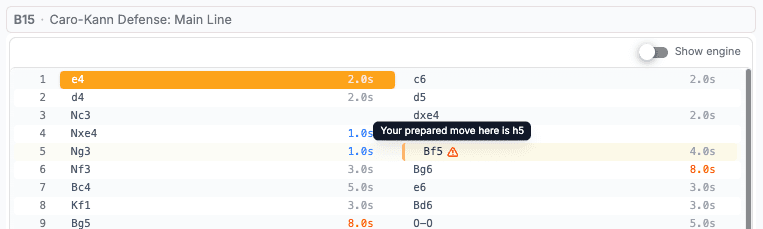
What a fifteen-minute post-mortem looks like now
The reason club players skip the post-mortem is not laziness. It is that the ritual requires a stronger player with time, and that person is rarely available at eleven at night after a lost blitz game. Chessalyz was built to be that person's questions, on demand. Upload the game, or let it sync from Chess.com or Lichess. Two to five minutes later, Matty has found the two or three moments that decided it and asks about the first one. You write what you were thinking. It reads your answer and coaches from there. The moments become flashcards; the game review shows where you left your opening prep; your explorer shows what opponents actually play against you.
The questions are modelled on the ones FM Dalton Perrine asks in his own lessons. The point was never to replace him. It was to make sure that the post-mortem happens, every game, for the players who would otherwise never get one.
- 1.de Groot, A. D. (1965). Thought and choice in chess. Mouton. (Original work published 1946.) archive.org/details/thoughtchoiceinc0000groo
- 2.Chase, W. G., & Simon, H. A. (1973). Perception in chess. Cognitive Psychology, 4(1), 55–81. doi.org/10.1016/0010-0285(73)90004-2
- 3.Gobet, F., & Simon, H. A. (1996). Templates in chess memory: A mechanism for recalling several boards. Cognitive Psychology, 31(1), 1–40. doi.org/10.1006/cogp.1996.0011
- 4.Ericsson, K. A., Krampe, R. T., & Tesch-Römer, C. (1993). The role of deliberate practice in the acquisition of expert performance. Psychological Review, 100(3), 363–406. doi.org/10.1037/0033-295X.100.3.363
- 5.Macnamara, B. N., Hambrick, D. Z., & Oswald, F. L. (2014). Deliberate practice and performance in music, games, sports, education, and professions: A meta-analysis. Psychological Science, 25(8), 1608–1618. doi.org/10.1177/0956797614535810
- 6.Charness, N., Tuffiash, M., Krampe, R., Reingold, E., & Vasyukova, E. (2005). The role of deliberate practice in chess expertise. Applied Cognitive Psychology, 19(2), 151–165. doi.org/10.1002/acp.1106
- 7.Campitelli, G., & Gobet, F. (2008). The role of practice in chess: A longitudinal study. Learning and Individual Differences, 18(4), 446–458. www.sciencedirect.com/science/article/abs/pii/S104160800700129X
- 8.Di Stefano, G., Gino, F., Pisano, G. P., & Staats, B. R. (2014). Making experience count: The role of reflection in individual learning (HBS Working Paper No. 14-093). Harvard Business School. www.hbs.edu/faculty/Pages/item.aspx?num=63487
- 9.Kotov, A. (1971). Think like a grandmaster (B. Cafferty, Trans.). Batsford.
- 10.Moxley, J. H., Ericsson, K. A., Charness, N., & Krampe, R. T. (2012). The role of intuition and deliberative thinking in experts' superior tactical decision-making. Cognition, 124(1), 72–78. doi.org/10.1016/j.cognition.2012.03.005
Your last game has a question in it.
Connect Chess.com or Lichess, or paste a PGN. Chessalyz finds the moments that decided the game, asks what you were thinking, and coaches from your answer. Five games a month are free.
Try it on your last game- Why writing down your reasoning makes a chess lesson stick
Fifty years of memory research say the same thing: what you generate yourself, you keep. What you read off a screen, you lose. Here is why a coach asks before they tell.
- The engine can't teach you. Here is what a question does that +1.3 cannot.
Feedback only works when it lands on a reason. An evaluation is a grade with nothing underneath it. A question makes you commit, and a committed error is the one you remember correcting.
- Make new mistakes: why your flashcards should be your own blunders
Retrieval beats re-reading, spacing beats cramming, and a position you actually lost beats a puzzle you never met. The research behind flashcards built from your own games.