

Make new mistakes: why your flashcards should be your own blunders
Retrieval beats re-reading, spacing beats cramming, and a position you actually lost beats a puzzle you never met. The research behind flashcards built from your own games.
Published 2026-09-03
There is a position you have lost before. Not a similar one, the same one, or near enough that the same idea kills you every time. You know this because you have said “again?” out loud at your screen. Nobody improves by never making mistakes. Improvement is when the mistakes change. That is what “make new mistakes” means, and there is a surprisingly precise science of how to retire an old one.
Being asked beats being shown
The single best-supported finding in learning science is that trying to recall something strengthens it more than looking at it again. In the study that made the effect famous, students read a prose passage and then either reread it or wrote down what they could remember. Five minutes later the rereaders looked better. A week later the students who had tested themselves remembered about 61 percent of the material; the rereaders, about 40.1
A meta-analysis of 159 effect sizes puts the average advantage of testing over restudy at half a standard deviation, larger when the test demands recall rather than recognition.2Retrieval even beat concept mapping, an elaborate study technique, on both fact and inference questions, and it did so for students who had confidently predicted the opposite.3The most cited review of study techniques rates practice testing as one of only two “high utility” methods.4
A flashcard is a retrieval test with the answer hidden. A puzzle is a retrieval test with a board. Re-watching the engine line is rereading.
Later beats now, and the best “later” keeps growing
The other “high utility” method in that review is distributed practice: spreading study across time instead of massing it.4A synthesis of 317 experiments found spaced study reliably beats cramming, and found something more useful: the ideal gap between sessions grows with how long you want to remember. If you need it next week, review in a day or two. If you need it next season, review in a couple of weeks.5
One honest boundary: that synthesis covers verbal recall. Nobody has established the optimal schedule for chess positions, so any app, including ours, is applying a well-supported principle rather than a proven chess-specific interval. The principle is that a position you got right should come back later than last time, and a position you got wrong should come back sooner. Every serious spaced-repetition system does that; the exact numbers are engineering, not science.
Mixed beats blocked
Doug Rohrer and Kelli Taylor gave students maths problems either blocked by type or shuffled together. Shuffled practice felt worse and scored worse during the session. A week later the shuffled group did far better, because they had practised the skill that blocked drills never test: working out which kind of problem you are looking at.6
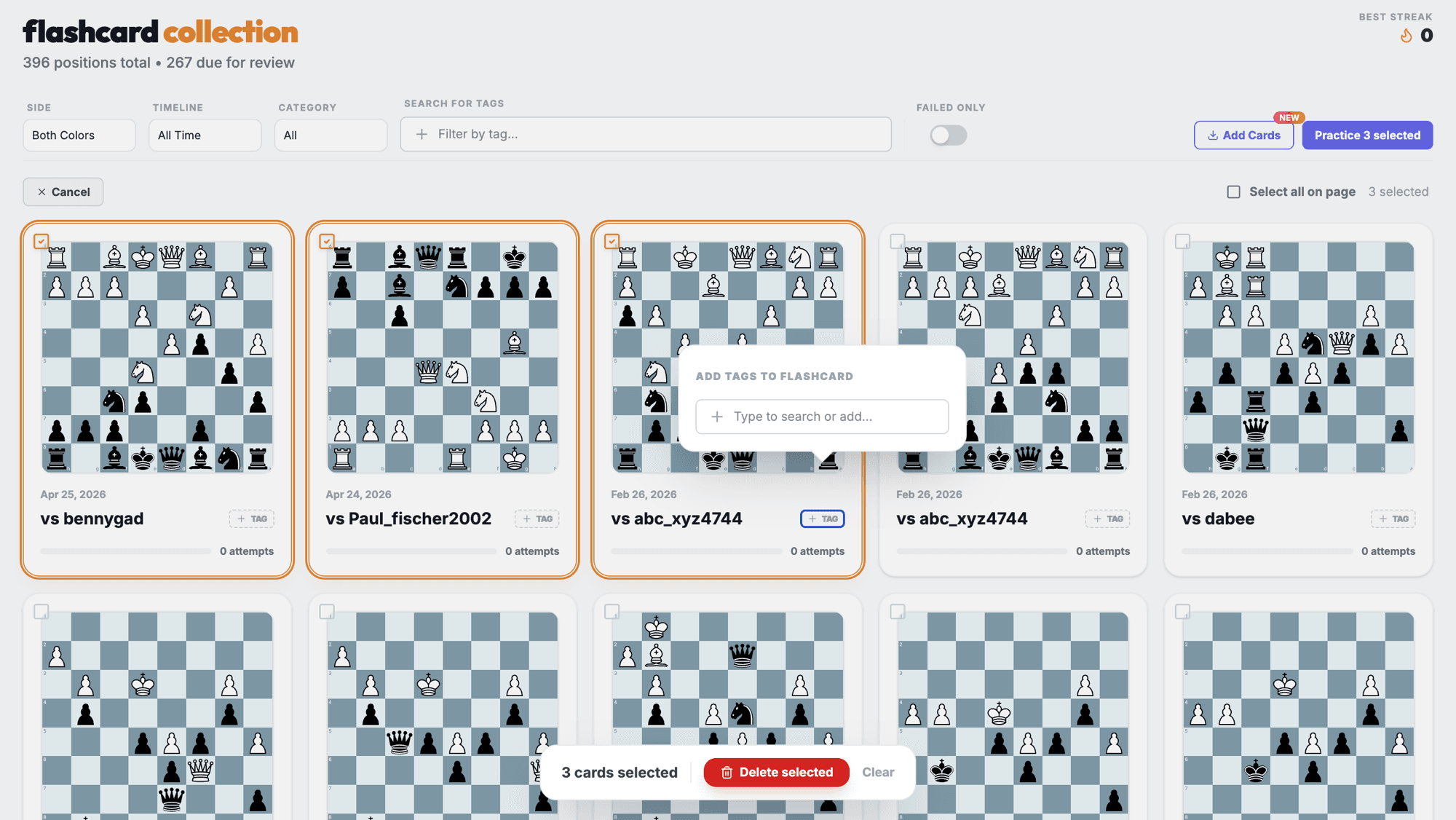
Most tactics trainers are blocked by design. “Forks, 20 puzzles.” The label does the hardest part of the work for you. A deck built from your own games is interleaved by nature: an opening slip, then a middlegame tactic, then an endgame you misjudged, in whatever order you played them, with no label telling you what to look for. That is harder, and it is the version that transfers to a real game, where nobody tells you a fork is coming.
The positions you meet are the positions you need
Chess expertise is, to a surprising degree, memory. Masters shown a real position for a few seconds can reconstruct it almost perfectly; novices cannot. Show both a random arrangement of pieces and the master's advantage nearly vanishes.7The explanation that has held up is that strong players carry a large library of familiar patterns, later refined into flexible templates, and see positions through it.8
The question, then, is which patterns go into your library. A puzzle collection gives you positions somebody else reached. Your own games give you the positions you actually reach: your openings, your opponents' habits, your recurring misjudgement about when a pawn grab is free. A card made from the moment your last game turned is a pattern you are guaranteed to meet again, with a story attached, and a question attached to the story.
Errors, it turns out, are not something to route around. Janet Metcalfe's review of the literature concludes that making a mistake and then receiving the correction is better for learning than being protected from the mistake, especially when you were confident.9Your blunders are not the waste product of your training. They are the curriculum.
Every questioned moment becomes a card
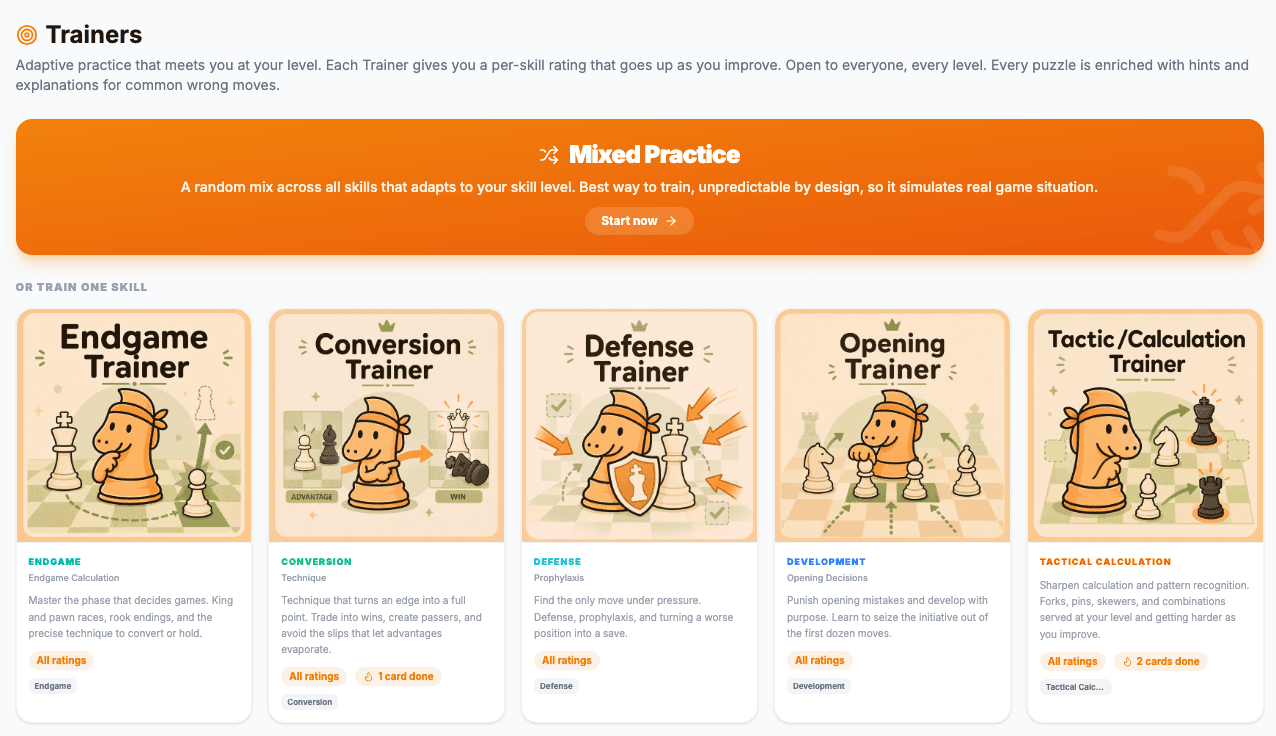
When Matty questions a moment in one of your games, that position can become a flashcard in a click, named and linked back to the game. The deck is spaced: a position you answer cleanly comes back later than last time, one you miss comes back sooner. It is interleaved, because it is drawn from whatever you actually played. And it is yours, so every card carries the memory of the game it came from. The skills trainer sits alongside for the patterns you have not met yet, served at your rating, with hints that teach the idea rather than reveal the move.
- 1.Roediger, H. L., III, & Karpicke, J. D. (2006). Test-enhanced learning: Taking memory tests improves long-term retention. Psychological Science, 17(3), 249–255. doi.org/10.1111/j.1467-9280.2006.01693.x
- 2.Rowland, C. A. (2014). The effect of testing versus restudy on retention: A meta-analytic review of the testing effect. Psychological Bulletin, 140(6), 1432–1463. doi.org/10.1037/a0037559
- 3.Karpicke, J. D., & Blunt, J. R. (2011). Retrieval practice produces more learning than elaborative studying with concept mapping. Science, 331(6018), 772–775. doi.org/10.1126/science.1199327
- 4.Dunlosky, J., Rawson, K. A., Marsh, E. J., Nathan, M. J., & Willingham, D. T. (2013). Improving students' learning with effective learning techniques: Promising directions from cognitive and educational psychology. Psychological Science in the Public Interest, 14(1), 4–58. doi.org/10.1177/1529100612453266
- 5.Cepeda, N. J., Pashler, H., Vul, E., Wixted, J. T., & Rohrer, D. (2006). Distributed practice in verbal recall tasks: A review and quantitative synthesis. Psychological Bulletin, 132(3), 354–380. doi.org/10.1037/0033-2909.132.3.354
- 6.Rohrer, D., & Taylor, K. (2007). The shuffling of mathematics problems improves learning. Instructional Science, 35(6), 481–498. doi.org/10.1007/s11251-007-9015-8
- 7.Chase, W. G., & Simon, H. A. (1973). Perception in chess. Cognitive Psychology, 4(1), 55–81. doi.org/10.1016/0010-0285(73)90004-2
- 8.Gobet, F., & Simon, H. A. (1996). Templates in chess memory: A mechanism for recalling several boards. Cognitive Psychology, 31(1), 1–40. doi.org/10.1006/cogp.1996.0011
- 9.Metcalfe, J. (2017). Learning from errors. Annual Review of Psychology, 68, 465–489. doi.org/10.1146/annurev-psych-010416-044022
Your last game has a question in it.
Connect Chess.com or Lichess, or paste a PGN. Chessalyz finds the moments that decided the game, asks what you were thinking, and coaches from your answer. Five games a month are free.
Try it on your last game- Why writing down your reasoning makes a chess lesson stick
Fifty years of memory research say the same thing: what you generate yourself, you keep. What you read off a screen, you lose. Here is why a coach asks before they tell.
- The engine can't teach you. Here is what a question does that +1.3 cannot.
Feedback only works when it lands on a reason. An evaluation is a grade with nothing underneath it. A question makes you commit, and a committed error is the one you remember correcting.
- Learning by thinking: what a fifteen-minute post-mortem does that another game does not
Masters have always analysed their own games. Cognitive science explains why that habit, not raw volume, is what separates the players who improve from the players who just play.